



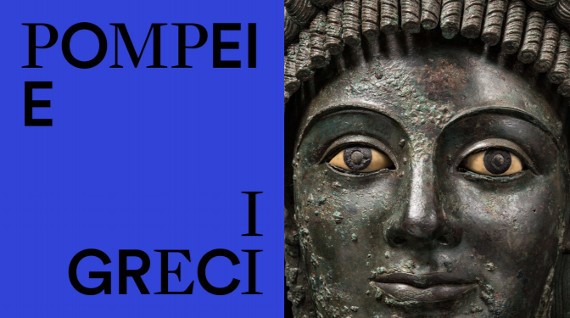
‘Pompeii and the Greeks’ tells the story of a meeting. It begins in an Italian city, Pompeii, and examines the frequent contact it has with the Greek Mediterranean. By tracing craftsmen, architects, decorative styles and focusing on precious imported objects, but also on Greek graffiti inscriptions on city walls, the display sheds light on the many diverse souls of an historic city, and its temporary and unstable identities.
Over 600 finds are exhibited, including ceramics, ornaments, weapons, architectural elements, silverware and Greek sculptures reproduced in the Roman age, sculptures from Pompeii, Stabiae, Sorrento, Cumae, Capua, Poseidonia, Metapontum, and Torre di Satriano. There are even inscriptions in Greek, Etruscan, and Paleo-Italic which were the diverse languages spoken. The display starts from both a scientific project and ongoing research, which has for the first time shed light upon unknown elements of Pompeii. The objects, hailing from major national and European museums, are divided into 13 thematic sections and reinterpret places and monuments of the Vesuvian city with their own ‘biographies’, at a site that has always been under the public gaze.
The outfitting of the display, which takes place in Pompeii's Palestra Grande, is designed by Swiss architect Bernard Tschumi and includes three immersive audiovisual installations, run by Canadian studio GeM (Graphic eMotion).
‘Pompeii and the Greeks’ illustrates to the general public the charm of a non-linear and multi-central historical narrative, composed of multiple and contradictory identities, as well as of layered languages, which were consciously reused in the Tale of the Mediterranean. A narrative that indeed should be considered and compared with the dynamism of contemporary times comprising migrations and conflicts, meetings and culture clashes.
The display of Pompeii is the first stage of an display programme, which is being carried out in conjunction with with the Archaeological Museum of Naples where in June there will be the inauguration of an display themed ‘Metamorphoses’ dedicated to Greek myths in both Pompeii and the Roman world.


